
Wickard
WashU Law-Wickard
About the Challenge
Deadline: June 25, 2026 at 5:00pm EST
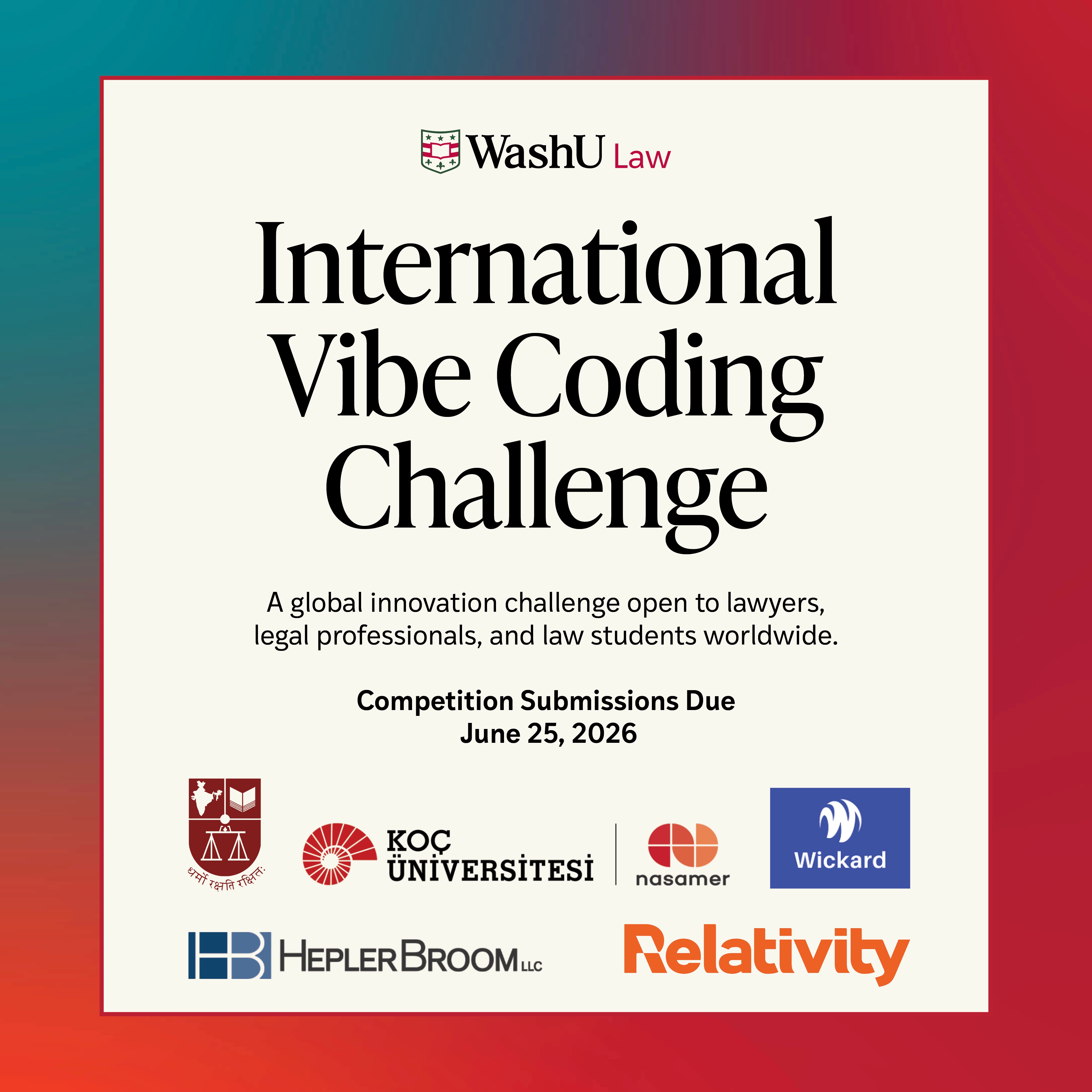
The International Vibe Coding Challenge is a global innovation challenge open to lawyers, legal professionals, and law students worldwide. The Challenge invites participants to design and prototype practical legal tools using AI- assisted, natural-language, low-code, or “vibe coding” development approaches. The emphasis is on real legal workflows, responsible AI use, and professional judgment rather than production-ready software.
*This competition is an educational initiative only. It does not create an attorney-client relationship, employment relationship, or partnership.
**Participants should assume submissions, names, information, and demos may be publicly showcased. No confidential or proprietary third-party information may be included.
Challenge Objective
Participants will conceptualize and prototype a legal practice tool that demonstrates how vibe coding techniques can improve efficiency, accuracy, access, or decision-making in legal work. The Challenge emphasizes: (1) Practical legal relevance (2) Responsible AI use (3) Ethical and professional awareness (4) Clear communication of limitations and risks
Challenge Prompt
Design and prototype a tool that meaningfully improves or creates a real legal workflow using AI-assisted or natural-language-driven development methods, without using real client data. The tool must relate to at least one of the following areas: (1) Legal research or analysis, (2) Contract drafting, review, or management, (3) Litigation or dispute resolution workflows, (4) Regulatory compliance or risk assessment, (5) Internal law firm or legal department operations, (6) Access to justice or legal education
Project Requirements, Deliverables, and Deadlines
To enter the competition, participants must submit by June 25, 2026 (by 5:00pm EST) both: (1) a recorded demonstration of their vibe-coded solution, and (2) a brief written explanation (max 500 words), describing the problem they are solving and the solution they developed. The specific requirements are as follows: (1) Recorded Demonstration: a recorded demo video (2-7 minutes), submitted via an accessible Google Drive link, YouTube link, or similar link format, (2) Written Explanation: a written description (max 500 words) explaining the legal problem addressed and the proposed solution, along with its benefits and known limitations, risks, or ethical considerations.
Criteria for Winning Project
The top three submissions will be recognized, and the top-ranked submission will be named the winner. Submissions will be evaluated based on: (1) Practical utility, including whether the tool addresses a real legal problem and offers meaningful value in practice, (2) Legal soundness, including whether the tool reflects coherent legal reasoning, appropriate limits, and professional judgment, (3) Responsible AI use, including whether the submission acknowledges risks, limitations, and ethical considerations, (4) Execution and clarity, including whether the tool is well built, clearly explained, and professionally presented.
Eligibility
The Challenge is open internationally to: (1) Licensed attorneys in any jurisdiction, (2) In-house counsel and legal operations professionals, (3) Paralegals, compliance professionals, and legal technologists, and (4) Law students and recent graduates. Participants may compete individually or in teams. All submissions, demos, and communications must be conducted in English language.
Permitted Tools and Methods
Participants may use any combination of: (1) Large language models and AI assistants, (2) No-code or low-code platforms, (3) APIs and workflow automation tools, (4) Prompt engineering and structured reasoning workflows All submissions must be created from scratch and may not incorporate or rely on pre-existing codebases, templates, or commercial products. Participants remain responsible for compliance with applicable laws, professional rules, and third-party platform terms.
Data, Ethics, and Professional Responsibility Requirements
Strict compliance with the following is mandatory. Violations may result in disqualification. (1) No real client data may be used, uploaded, processed, or referenced, (2) All data must be fictional, synthetic, anonymized, or publicly available, (3) Participants remain fully and individually responsible for compliance with applicable laws, professional rules, and third-party platform terms, (4) Submissions must not be presented as legal advice, (5) Jurisdictional unauthorized practice of law must be fully considered, (6) Known risks, limitations, and failure modes must be acknowledged.
Questions, Comments, or Partnership Inquiries
Questions, comments, or partnership inquiries may be directed to Oliver Roberts at oliver@wickard.ai